Wednesday, September 29, 2010

Instructions for the Cami/Tube Top Corset Pattern

This is the photo tutorial for my Cami/Tube top Corset Pattern that's available on Etsy


CUTTING YOUR T-SHIRT APART
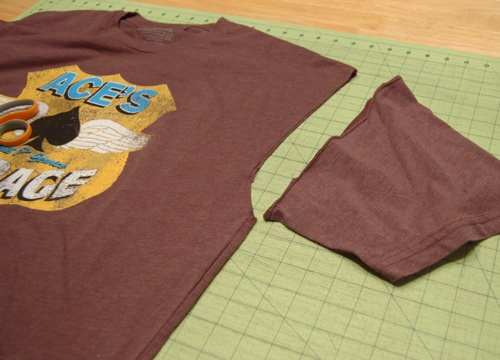
Completely separate the sleeve from the shirt body
You do not need the sleeves for this project


The shoulders and collar are joined with a seam that runs across the top of the shirt. Cut these seams.


Split the shirt down each side from the armpit to the bottom. You should now have 2 pieces: Front and Back


Fold the front and back of the shirt in half. Be sure to take time and center your image. Do the same for the back. If your back does not have an image on it you can save time by laying the front folded fabric on top of the back folded fabric - if your back has an image on it cut each piece separately.


Place the pattern piece on the fold and make sure to center your image - try to avoid placing the V (cami) or top edge (tube top) on any ink.
Cut the front and back of the shirt. I like to cut the bottom of the shirt off first and save the scrap for a different project or for a bottom band if I want to add one ***this pattern does not include the band because it's a little more difficult to sew on with a regular sewing machine - if you want to add one just cut a 6 inch wide strip and make it about 4-5 inches shorter than the width of the bottom edge of your shirt. Ease the band into the bottom edge by pulling a little while you sew it to the bottom - to attach it use a straight stitch and then a zig-zag stitch along the sewn edge.


Cut 2 strips of stretch lace or fold-over elastic for shoulder straps in the following lengths (Cami Only):
Small: (2) 17 inch strips
Medium: (2) 18 inch strips
Large: (2) 19 inch strips

SEWING YOUR SHIRT

The following instructions apply to the cami corset only


Take your stretch lace or fold-over elastic and sew it across the V-neckline slightly pulling evenly while you sew.


If you're using stretch lace use a zig-zag stitch along the upper edge and then go over it again with a straight stitch along the bottom edge of the lace. If you're using fold-over elastic you can use a straight stitch.


Do this for the front and back pieces.


Here's an example of how it should look like on the other side of the fabric.


Fold your fabric with right sides facing each other and pinch the V-neck.


Sew in place just on the center front- only do this step for the front.


Take each shoulder strip that you cut earlier and attach one side of the strip to the front armhole edge of the shirt. Only stitch where there's fabric.


When you get to the top of the armhole where it meets the V-neck back-stitch to secure your thread and grab your back piece. Do the same step to the back piece. Be very careful not to twist you strips when you sew each pattern piece to the lace/elastic.


Place the right sides of the front and back facing together and sew the side seams. There is a 1/4 inch seam allowance included. Use a regular straight stitch on each side - make sure to back-stitch the top seams so that you secure the fold-over elastic/lace. This is where the most stress is so make sure you have securely sewn the seams to avoid it tearing on you while you're wearing your top.


Finish your edges with a zig-zag stitch. Back-stitch at the underarm seam to secure your thread.


Split the back of your shirt down the center.


Usually you will be able to see a crease from when you folded in in half to cut it earlier.


Hem the bottom of your top using a 1" hem allowance. I would recommend using a zig-zag stitch. Press your seam.


Fold the center back edges in 3/4 of an inch and stitch (zig-zag).


Remember to press both your hem and center back edges


Grab your grommet tape and cut one of the ends in the center between two grommets. Lay over your shirt to determine the length you need and cut the other end the same way


Pin your grommet tape onto the center back edge and tuck the ends under themselves by about 3/8 of an inch.


Make sure you count the grommets and have an equal number on each side. Use a zig-zag stitch across the top, sew down the inside of the seam and finally across the bottom edge. I use a universal sewing machine foot but some people prefer to use a zipper foot for this step. If you choose to do so make sure you use a straight stitch instead of a zig-zag to avoid accidentally breaking your needle on the zipper foot.


Cut all loose threads and use the 3 yards of satin lace to lace up your corset!


Burn the edges of your satin lace so they don't fray - you barely have to touch it - just make sure the ends melt just a little bit.
For this last step make sure you're in a well ventialated area and that you have plenty of water handy in case you light something on fire. Also, watch your fingers - it's easy to burn them!
If you're under 18 please get a parent to help you do this.


***If you just want a cami or tube top but no corseting just ignore the steps where you cut the shirt down the center back and add grommets. All other steps are the same.

If you have questions please feel free to leave a comment and I'll try to answer as best I can - feel free to help each other through the comments in this post :D

Have fun! Send me pics!!!

Thursday, August 12, 2010

New Legislation Could Impact Indie Fashion Designers On Etsy.

I’m not a lawyer. This is just my interpretation of the Innovative Design Protection and Piracy Prevention Act.

Only a few days ago Senator Charles Schumer (D-NY) introduced the Innovative Design Protection and Piracy Prevention Act (S. 3728). What follows is a brief, clear and simple interpretation of that legislation and how it could affect indie fashion designers for better or worse – and there is a worse.

Let’s be up front and honest, most of us aren’t as interested in politics as we should be. How many times have you flipped right past C-SPAN to get to Two And A Half Men without even considering what those old fogies in gray suits are debating? Don’t be too embarrassed; I do it too.

This handy little piece of proposed legislation is being sold as a way to offer intellectual property protection to unique and original fashion designs. Or more simply put, it means no copycatting or ‘borrowing’ other designers’ clever and crafty ideas unless you can combine them with enough of your own ideas and style to make a completely new and unique product. As it stands the U.S. is the only industrialized nation that is completely devoid of laws prohibiting the piracy of clothing. That pretty much means you can watch the Oscars then go and replicate every single dress you see on the red carpet and start a business selling copycat dresses – which is exactly what the designers at Faviana do. This isn’t slander; just check out the Celebrity Red Carpet Dresses link on their site and you’ll see they make no effort to hide it. In fact, they scream it – Hey these dresses are exactly like the ones see on the red carpet! That is, for a fraction of the price of course. It’s not nice, but it is legal and it’s big business.

So Mr. Schumer’s new law will attempt to put a stop to this sort of blatant replication. Don’t be misled; you wont be able to sue a fellow Etsian because she made a blue pea coat with wood buttons that maybe looks a little like the one you made last year. A coat is much too common and useful an item to copyright. Can you imagine how awful it would be if only one design house were allowed to make pea coats? Now, if someone buys your pea coat and then takes it apart, traces each piece, and remakes the exact pea coat with all of your unique little tricks and details that make it special and unlike all other pea coats, then that, under Mr. Schumer’s Piracy Prevention Act would be illegal. Sound good so far?

However, there are some sneaky little loopholes that small, independent designers need to be aware of. Like most laws, bills, and acts, there’s lots of room for interpretation, and like most legislation this act has the potential to do as much harm as good.

Let’s look back on that blue pea coat with wood buttons you made last year. Let’s say it was moderately popular and a dozen or so boutiques each ordered a size run. Now let’s say a buyer from the fictitious company Mega-Super-Fashion comes along, sees your pea coat and says to himself, ‘Hmm, I could easily reproduce these in my multi-million dollar factory, take a few stylish snapshots, and sell them as my own and make a killing.’ Right about now you’re probably thinking, ‘thank goodness I’d be covered by the Innovative Design Protection and Piracy Prevention Act.’ Unfortunately, it’s this very act that could be fodder for M-S-F to sue you.

If you cannot unequivocally document that that exact pea coat was designed and made by you (and you don’t have thousands to spend on a lawyer to take you to a federal trial) the big company can claim ownership of the design and, with a short, swift, and very aggressive cease and desist order, put you out of business and crush your dreams. This isn’t meant to imply that any company in specific would partake in such unscrupulous practices, but there is such thing as a ‘strike suit’ a strategy where companies target hundreds of small businesses at the same time, sending out letters from their law departments demanding just a few thousand dollars in order to avoid legal action. Schumer’s proposed act could be another avenue of attack for such below the belt punches.

The objective is to be aware that at this time clothing cannot be copyrighted. Once Schumer’s Piracy Prevention Act goes into effect you cannot sue or be sued for making and selling slightly similar garments to those sold by others. However, your unique work and the unique works of others will be protected from illegal duplication. It’s up to the designer to document her creations thoroughly and publicly with the U.S. Patent Office and other outlets. If you don’t have the resources to do this, at the very least you should save anything that proves your unique designs are yours. Post your designs to Flickr and Photobucket as these often show when images were uploaded. If you have a website, keep images of your work on your site in a hidden directory. Saving local newspaper articles, screenshots of blogs, and even logs of your sold Etsy listings can be beneficial if someone should steal your designs, or claim you have stolen theirs.

In summation, let’s be grateful that lawmakers are finally validating clothing design as an art form. Let’s also be thankful that on it’s surface the Innovative Design Protection and Piracy Prevention Act (S. 3728) sets out to protect all fashion designers and their unique ideas and designs. But at the same time let’s be weary that the law functions as a double edge sword to be used by those underhanded and savvy individuals that make up the less attractive side of the industry.

For more information check out:
http://www.cfda.com/
http://www.cfda.com/schumer-introduces-legislation-to-protect-fashion-design/
http://counterfeitchic.com/
http://freakonomics.blogs.nytimes.com/2010/03/03/behind-the-scenes-of-oscar-fashion/
http://faviana.com
http://www.lexisnexis.com/Community/copyright-trademarklaw/blogs/fashionindustrylaw/archive/2010/08/09/schumer-introduces-legislation-to-protect-fashion-design.aspx
http://www.tabberone.com/Trademarks/trademarks.shtml